Archive for the “Year of the System” Category

M3Dsubs-CDproject.jpg

This week I feel like we’re sort of slipping into the eye of a marvelous storm as we hit essentially the mid-point of a pretty cool project. That project is, of course, a sound system upgrade in our east auditorium.

I don’t have time for a lot of details right now, but I will say this: The last project I did on a scale close to this was at my last church in 2005 when I launched the blog. This project is a bit bigger, though, and I’ll have more on that in the coming weeks.

The timeframe for the process back in ‘05 was about 6 months. Once designs were finalized it was about a 3 1/2 month process/wait beginning in June of ‘05 and ending with the final installation at the end of September. If everything goes according to plan, we’re going to do this one in about 9 weeks.

I’m going to leave it at that for now. I’ll have more info on the process in the coming weeks as we get closer to an April install, and my brain has more capacity to download things.


Wondering if I should update my copy of….

Comments 3 Comments »

Venue Repairs

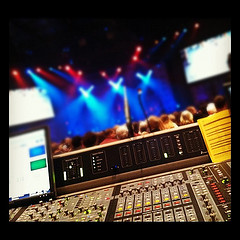
I’m not a fan of removing our Venue’s FOH rack from the rack where it’s mounted. This is because there is a single, blank rackspace directly below it. That blank space serves a purpose because it leaves room for excess cable to be dressed and hidden underneath the rack, but it’s not so handy when you have to remove the unit and that’s exactly what needed to happen to fix the Venue. But I’m getting ahead of myself…

Wednesday morning started off with a video shoot in the auditorium for the message coming up on Sunday. This particular message was part 2 of the Illusions series presented by Jeff Henderson. The message opens up with Jeff on video for the first couple minute followed by the real Jeff coming out from behind the screen to converse with himself. Of course, we needed to shoot the illusion Jeff prior to Sunday and Wednesday morning was the time to do that. So with the system roughed in we ran through the shoot without any major problems.

As soon as the shoot was finished I put the measurement mics back out and started to fine tune the system. For the first time that week, things started to come together with a standard system optimization process. I tweaked and walked around for a couple hours getting as satisfied with the main floor as I could for a first shot at the new speakers which was good because just before lunch the parts for the Venue came in.

After lunch I got started on the Venue and was quickly reminded why I am such a big fan of service loops. The entire FOH Rack needed to come out of our rack to work on it, but thankfully I had enough slack on all the cables that I could leave everything with the exception of power hooked up. The Venue’s CPU assembly is basically the entire lower half of the FOH Rack, but all of the connections are on the upper-half.

I had never torn a Venue apart to this degree before, so in all honesty I was sort of enjoying the idea of performing a CPU transplant. The repairs were pretty straight-forward. Disconnect everything from the CPU assembly to the rest of the FOH rack internally and then pull it out. The hardest part for me was just removing all the screws and making sure I got them all out. In fact, here’s a tip for all you Venue users who are thinking about repairing your own console: make sure you have an electric screwdriver because the thing is made of screws. I once asked about this and the reply was that they cut down on RF interference, and if you read Bob Katz’ Mastering Audio book you’ll know that RF can play with digital conversion so somehow all those screws might a good thing. Although, when you’re taking them all out knowing you have to put them back in, it’s not so much fun.

At any rate, the whole process took me about 2 hours, and if I had to do it again I could knock that down quite a bit. Once the CPU assembly was back in, I fired up the console and set about reinstalling all of our plugins. I left our original hard drive with the old CPU assembly since the new one used a new motherboard and had all the new drivers already installed on the new hard drive. I keep a USB drive with me at all times that contains all of our plugin installers including some custom installers I built for plugins that are missing them. In less than three hours I had the console back up and running.

With the console complete, I started working on our balconies and fills to have everything working for rehearsal that night. By the time 5 o’clock rolled around, everything was working for rehearsal. I spent Thursday doing some more minor tweaks to the system along with the mix.

Now that we’ve been running on the new drivers for a bit, I can honestly say that I’m happier than I’ve ever been with the rig. There is no perfect system and this one still has its quirks, but it plays a lot better than it ever has in my two years on it. Since the changeover, I’ve continued to tweak things here and there as the drivers break in, but I think we’re almost at the point where we can settle in on things for a few months without anything other than a weekly walk around the room to listen. That’s a nice place to be.

Comments Comments Off

Rehanging

Tuesday got off to a good start. We were feeling pretty good since everything was ready to go back in the air. We took some time to clean up the disaster zone we had created of old components and shipping materials, and waited for the riggers to return to get the boxes back in the air. I also took some time in the morning to roll out and setup my tuning rig running long enough cables to get my measurement microphones into the far reaches of the system’s coverage.

The riggers showed up just before noon and had things going back up relatively quickly. Once the boxes were back in the air, Luke started rewiring them while I started rolling out all of my tuning gear so that I could immediately start testing the boxes once he finished a cluster. However, after he finished the first cluster a new challenge came into focus.

First a little backstory. Roughly a year and a half ago there was an issue with the Venue’s FOH rack that cropped up. It related to a power issue on the motherboard, and the solution was to use a series of chemicals to clean the contacts on the power connectors. The fix was recommended for all consoles at the time, but unfortunately it wasn’t a permanent fix and would be something that would need to be repeated as part of ongoing preventative maintenance on probably an annual basis.

About a week prior to the speaker refurb, I started getting the error messages again. The nature of the problem is that over time more and more error messages happen which can get you closer and closer to an actual failure. After a quick email with Digi’s amazing customer service I decided I really needed to apply the fix sooner than later especially in a week when the console was going to get used more than during a typical week.

On a side-note, I really have to give shoutouts to the great customer service we received during the week from the folks at Clark ProMedia, Renkus Heinz, and Digidesign. No matter how confused or frustrated things got, these companies never stopped being an enormous help whenever and wherever they could. Customer service is HUGE for me and something that factors more and more heavily for me when it comes to investing in equipment. Now back to the story.

When I opened up the FOH rack to service it, things suddenly seemed a bit more urgent. Upon examination I discovered that the connector on the power supply appeared to have cooked around one of the pins. On another side note, I’m very thankful that I switched to an iPhone because it was so easy for me to take a quick picture and email it to Digi’s customer service to get their take. It looked bad to me, but I honestly wasn’t sure if it was a genuine problem or simply a natural side effect of the servicing from the year before. Digi’s immediate response confirmed my suspicions, and they got the ball rolling on a solution: replace the CPU assembly. It would be another day before I could truly fix the Venue so I put it back together and got it up and running because I still had work to do even though I only had about 90 minutes left for the day.

With the console running again, I set out to finish testing the boxes in the air which revealed that one of the boxes had the lows wired out of polarity. A quick trip to the amp room to flip the wiring on the back of the amp resolved that.

At this point I was really starting to run out of time, and I still needed to get the mains ballparked before I left; did I mention that I needed things running for an event at 9:30 Wednesday morning? My investment earlier in the year on building a new measurement rig for system optimization came in very handy along with my switch over to EASRA SysTune from Smaart for large scale optimization projects. I like SysTune because it allows the use of multiple mics that can be flipped simultaneously within the software and even averaged together live. Some guys actually have mic switchers set up so they can do this in Smaart, but it’s still easier for me to do within SysTune plus the live averaging of multiple mics is a cool and handy feature. For what it’s worth, I still use Smaart a lot, too–maybe another post on that someday….

So I threw all my mics out, got the delay times set in SysTune, roughed in the system EQ, walked the room a bit to where I was satisfied for the next morning, and still somehow finished in time to pickup my kids.

On Wednesday, the adventure continued….


Here’s a good book to read before facing weeks like this:

Comments 1 Comment »

Vintage 1995

The photo here is just one of the many components we recently retired from the main loudspeakers in the east auditorium. You can note the vintage of this particular component stamped on the board.

It has been a recurring theme for folks familiar with the system to talk about how worn out it has been for the last two years, and about a month ago the speakers reached a point where they could no longer work without audible distortion. The truth is I had been holding out on pushing for repairs since the grand plan was to upgrade our campus to the same level as our other campuses, but unfortunately the deterioration of the equipment beat us to it. So we opted to do the best we can with what we’ve got, and that meant finally giving our loudspeakers some much needed work.

So in a nutshell, we did a complete overhaul on our main loudspeakers a couple weeks ago. When I say complete, I mean we kept the cabinets and the grilles and the insulation and the little wires inside. OK, maybe by some standards it wasn’t complete, but for all intents and purposes, those boxes might as well be new at this point. And it was absolutely not fun getting them there. Over the last two years we’ve done a lot of driver replacing and loudspeaker surgery, but these boxes were by far the most difficult we’ve ever worked on.

We started the project first thing Monday morning by bringing in riggers to lower the boxes. We’ve worked on a lot of boxes in the air over the years, but for a project of this magnitude it is always easier and safer to just bring everything down to fix it on the ground. We had three clusters of three loudspeakers, and the design of the boxes also required the clusters to be blown apart to access the horns from the sides.

PA Driver Replacement

Given where the project ended up going, trying to do this in the air would have been nearly impossible.

Once the clusters were on the ground and apart, we started opening up the horn access panels, and that’s when things got crazy. It wasn’t long before we realized there was no way to do all the work we had to do without removing every component we could. If it had a screw in it, it had to come out regardless if it was getting replaced or not. We had to continually turn boxes upside down and on their side to get at things. Getting tools into the small spaces not really designed for tools also created a lot of frustration as the time seemed to fly past us.

When it came time for me to start work on the crossovers, there was more frustration and confusion as the new crossovers for the loudspeakers had been customized for us at the factory since these speakers have been discontinued for quite a while now. The new components were a different size than the old ones so we had to re-drill the boxes to make them fit. In addition, the labels on the PC board didn’t match with the schematics we had been given so there were a lot of photos and phone calls being sent back and forth.

By five o’clock we hadn’t even finished one box, and did I mention that we needed everything done by Tuesday morning? In comparison, we did a similar project on our west auditorium PA last summer and had everything changed out in half a day once the boxes were on the ground.

Thankfully our volunteers rock, and some of them were gracious enough to come in at the last minute and lend a hand to fixing everything. I don’t exactly know what happened, but at some point things started clicking and we were able to get all the new components in and tested just before facilities could kick us out to lock up the building at eleven.

Monday was a very long day, and I knew it was going to be a hard day going into the project. However, my hope was that we could take it a little easier for the rest of the week while I focused on tuning the system, and the rest of our team focused on getting ready for Sunday. As it turned out, Monday was definitely the hardest day of the week, but I can’t say that things really got easier for the rest of it….

….to be continued….

Comments Comments Off